by The Boomer Gal | Jun 12, 2013 | Marketing
Brand narrative has been changing thanks to digital marketing and social media. No surprise there right?
The basics of a brand narrative I believe boil down to concepts like those in the following quotes.
From Douglas Rushkoff, an author on media theory who said,
“We use stories to understand our world, orient ourselves, motivate our employees, communicate our brand values and even tout our stock valuation.”
(more…)

by The Boomer Gal | Nov 20, 2012 | Communications
 Pervasive communication is the fancy pants way of labeling CHAOS in communications. Maybe that’s not entirely fair. You see the Internet has given us access to the world’s largest water cooler. Anyone who has been around the water cooler a couple of times knows, that the conversation is often scattered and quick — non-linear — bits and pieces of the bigger communications picture.
While older generations perfected direct communication through sharing written language and spoken language, culture has changed to the point where those same generations may not even recognize communication as we use it today.
Let’s take my favorite social media – Twitter – as an example of the pervasive communication phenomenon.
Twitter is a social media platform that was based on SMS texting technology. That technology was limited to 140 characters of text that could be sent in one message. Only having 140 characters severely limits your ability to write in complete sentences and get your point across.
Let’s try an example: “Four score and seven years ago our fathers brought forth on this continent a new nation, conceived in liberty, and dedicated to the proposition that all men are created equal. ” This famous opening to Abraham Lincoln’s Gettysburg Address is 30 words and 175 characters (yes spaces do count).
Now if Lincoln were to tweet this same sentence on Twitter, it might go something like this: “87yrs ago the USA was born – liberty and equality for ALL! TY forefathers. You ROCK!” which is only 84 characters leaving Lincoln’s followers 56 characters to comment during a retweet.
Lincoln was engaged in traditional written and verbal communication that was heard live on November 19, 1863 by approximately 15,000 people and reported by newspapers around the United States the days following, increasing the audience substantially. By today’s standards, based on Barack Obama’s Twitter following, Lincoln would have had upwards of 4 Million followers in 1863. His tweet could have potentially been seen, in real time, by 267 times the original 15,000 people.
That’s just one way pervasive communication has changed our language and the reach of that language.
Pervasive Communication is not a death knell.
Just because our communications practices have become more chaotic and non-linear does not mean they’re not effective. It also doesn’t mean you can afford to ignore the methods. They are imperfect and certainly not as beautiful as the Gettysburg Address, but they occur in greater quantity in more places than we ever imagined. And that is an opportunity.
Your strategy can be simple. Start by listening to what and where your ideal customers and clients are having conversation. There is a search function built in to all social media platforms. Google Alerts can help you set up other ways of keeping tabs on your business name or your personal name.
My recent guest on ACT LOCAL Marketing, Fred McClimans, encouraged businesses to simply monitor social media for their name and respond when mentioned. That’s really simple while keeping your business on top of things in the eyes of an increasingly savvy pervasive communication inspired public. Fred also mentioned how online is THE place where word of mouth escalates dramatically. “Word of mouth is dominant,” he states.
Word of mouth definitely carries a lot of weight with consumers. Pervasive communication has made word of mouth easy to spread. Bad word of mouth will move like a virus through the online world, but good word of mouth moves fast too. Much faster than traditional face-to-face local communication mediums.
Rather than peg pervasive communication as the ubiquitous (I just love that word) sludge gumming up the wheels of communications, see it as an opportunity to engage with your clients, customers, vendors and employees on their terms. Don’t be the last one to take this new style of communication seriously, because that’s asking to be left behind. Or as our good friend Abe Lincoln said, “Things may come to those who wait, but only the things left by those who hustle.”
Thanks to @fredmcclimans for his thoughts on pervasive communication, 11-19-2012 on ACT LOCAL Marketing.

by The Boomer Gal | Sep 25, 2012 | Social Media
Not Your Usual Social Media Management Article
Social Media Management Audio Version Oy, enough already with the social media management, the pinning, the liking, the following…
Sometimes it feels like this is all anybody talks about, all I’m training on, all my audiences want to know more about when I’m sharing with novices in the online world.
And therein lies the key factor. Novices in the online world. There are your early adopters and then there are those that come late to the party. Now I’ve often been an early adopter much to my own detriment [the Saturn automobile, Gateway desktop computer and iPad one to name a few] but in business, early adoption can be really stupid or a one-way ticket to SUCCESS.
The problem for small business marketing, is knowing when to pull that trigger. And sadly, most small and medium sized business owners take the wait and see approach, which as a fiscal conservative, I can’t blame them for.
However…
(more…)

by The Boomer Gal | Jul 24, 2012 | Marketing

If you want to reach the under 30 Millenials,
then you better know how to text.
Mobile Marketing in Local Business
I believe that mobile marketing will be the bridge that connects traditional direct marketing for small business with the world of online marketing. Let’s face it, the world has changed and it’s not finished yet.
If you want to converse with a Millenial [AKA: Generation Y, Echo Boomers and Generation Next] who in general terms is anyone born from approximately 1980-2001, warm up those thumbs!
It’s very difficult to communicate with a Millenial if you don’t text. It’s their preferred method of communication and they are the second largest age demographic after baby boomers.
To ignore them in your local marketing is a serious mistake. Generation Y were the first to grow up with computers in their homes and 500 television channels. They think nothing of walking around with a phone that has ZERO wires connected to a wall.
by The Boomer Gal | May 22, 2012 | Social Media
Foursquare and three years ago…
Foursquare and three years ago...Audio Version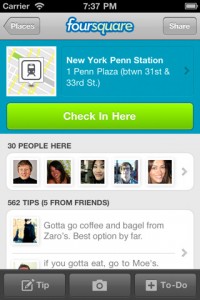
a social networking site was created by Dennis Crowley & Naveen Selvadurai, on Dennis’ kitchen table no less.
foursquare [fohr skwair] , noun, a location-based social networking website for mobile devices, such as smartphones.
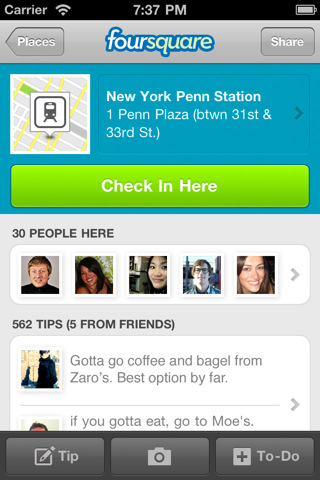
Used in a sentence: “That was my most amazing foursquare check-in ever, I can’t believe I unlocked the Penn Station swarm!” or “Are you going to check in on foursquare and unlock that coupon for 20% off?”
So, what is foursquare and should you be worried about using it daily?
I’ve had discussions with friends and family about using this fun and innovative social networking app. Foursquare is a Geo-location based game that encourages users to check-in [noun] or check in [verb] but never checkin [grammatically wrong in every way], to the various businesses and sites in the world they visit daily. No big deal right? Well maybe yes, maybe no.
You see, like any good social networking platform, the emphasis is always on the social. Which means, you’re encouraged to invite friends, make friends, friend friends…you know the drill. But the difference with foursquare (which is stylized to always be spelled in lowercase, which I feel obligated to point out lest I offend any spelling champions or grammar Nazis) is the location-based aspect of the network.
(more…)